


How to Test Aquarium Water: A Simple Guide for Beginners
Think of testing your aquarium water as getting a regular health check-up for the little world you've created. It’s easy to be fooled by crystal-clear water, but the real story is told by the invisible chemistry at play. This isn't just a tedious chore; it's the single best form of preventative care you can provide, letting you catch problems long before they harm your fish.
Why Water Testing Is Your Most Important Task
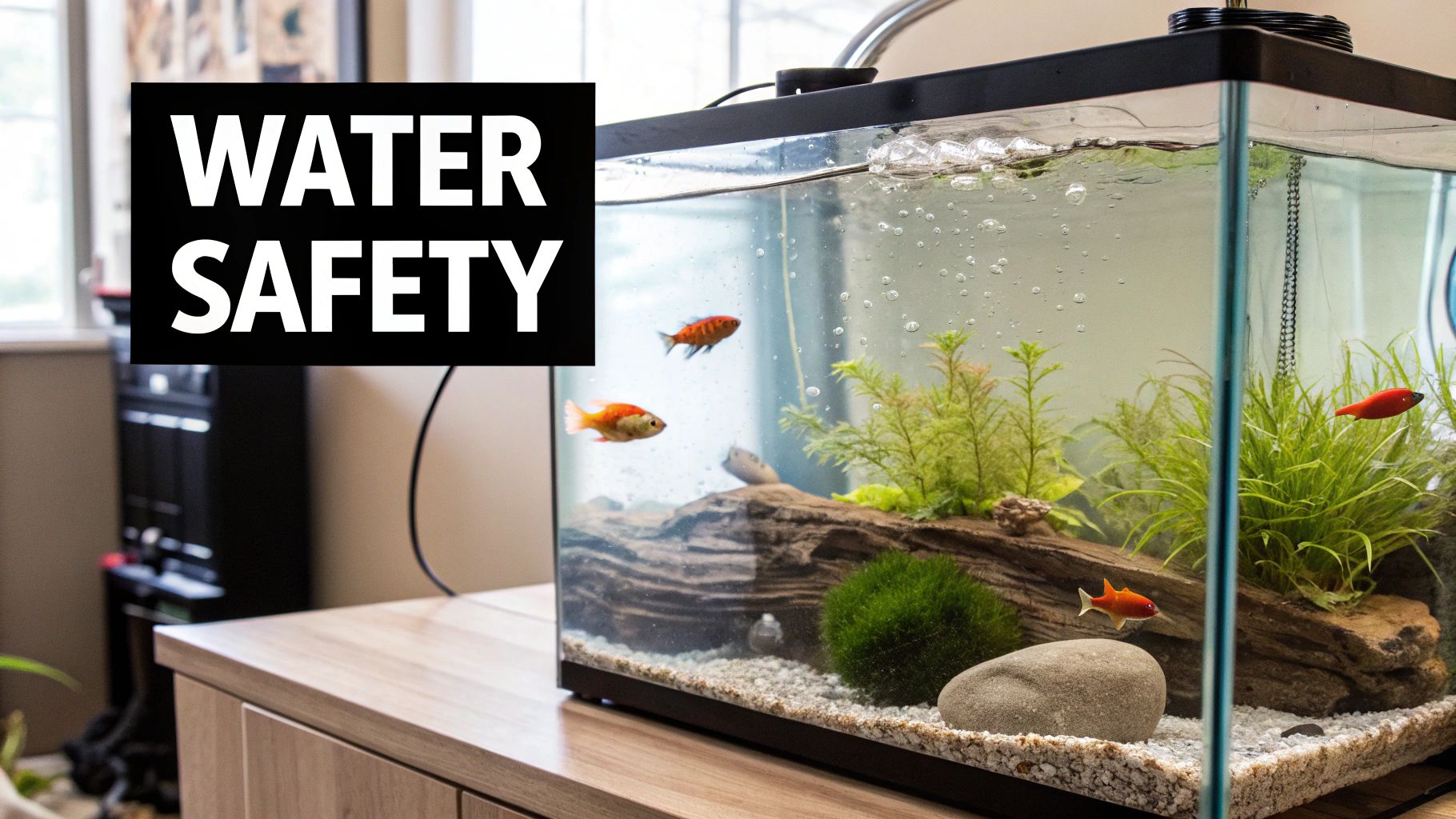
Even an aquarium that looks immaculate can harbor a silent buildup of toxic compounds. In fact, poor water quality is one of the biggest culprits behind fish stress, disease, and unexplained losses. The only way to know what’s truly going on is to test.
This is especially true when you're first setting up a tank and going through the initial "cycling" process. This is when the crucial colonies of beneficial bacteria are finding their footing. But don't think it stops there—regular testing is a lifelong habit that ensures a stable, healthy environment for years to come.
The Key Parameters You Need to Know
For most aquarists, success boils down to keeping an eye on a handful of key parameters that directly affect the well-being of your fish. Mastering these is the foundation of good aquarium keeping.
To give you a clear picture, here's a quick-reference table outlining what you'll be testing for, the ideal levels for a typical setup, and why each one matters so much.
Key Water Parameters for a Healthy Aquarium
| Parameter | What It Measures | Ideal Range (Community Tank) | Why It's Important |
|---|---|---|---|
| Ammonia (NH₃) | Toxic waste from fish, uneaten food, and decaying matter. | 0 ppm (parts per million) | Highly lethal, even at low levels. The #1 toxin to watch for, especially in new tanks. |
| Nitrite (NO₂) | The byproduct of bacteria breaking down ammonia. | 0 ppm | Still very toxic to fish. Its presence shows your cycle is in progress but not yet complete. |
| Nitrate (NO₃) | The final, less-toxic end product of the nitrogen cycle. | Under 20-40 ppm | Becomes harmful at high concentrations. Controlled primarily through regular water changes. |
| pH | The acidity or alkalinity of the water. | 6.8 to 7.8 | Drastic swings cause stress. Different fish have different preferences. |
| GH & KH | General & Carbonate Hardness; measures mineral content. | Varies by fish species | GH is vital for fish health; KH provides a buffer to keep your pH stable. |
Understanding these numbers is what separates a passive fish-keeper from a proactive and successful aquarist.
Beyond the "big three" of the nitrogen cycle, you'll also want to keep an eye on parameters that affect the overall chemical stability of your water. This includes pH, which is the measure of acidity, and water hardness (GH and KH), which plays a huge role in preventing dangerous pH swings.
Testing reveals the unseen. A log of your results over time is far more powerful than a single reading, helping you identify trends and understand your tank's natural rhythm.
Consistently tracking these elements is how you truly take control of your aquarium's health. You'll stop reacting to problems and start preventing them altogether.
Picking the Right Aquarium Water Test Kit
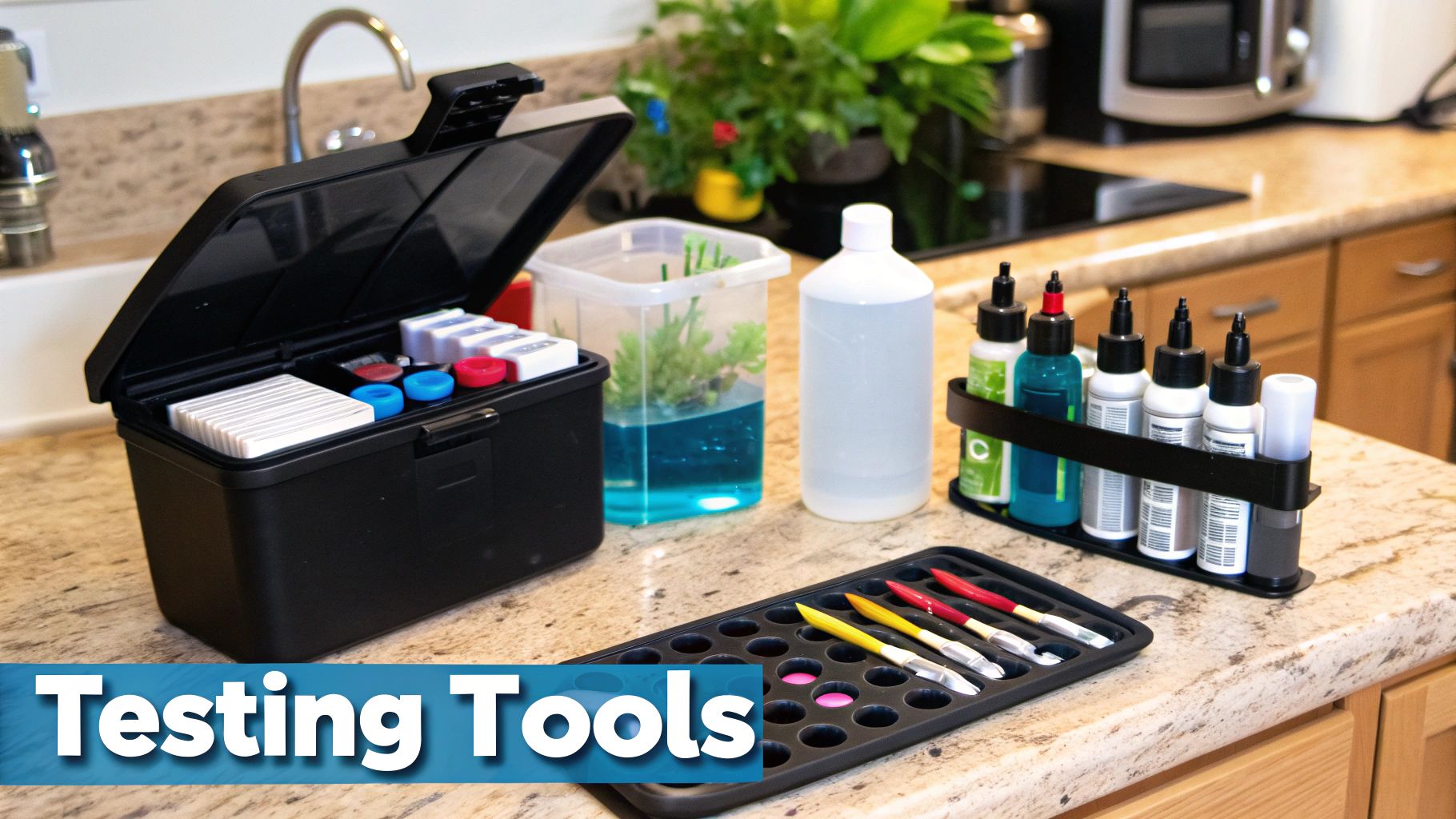
When you're figuring out how to test your aquarium water, your first big choice is the test kit itself. Walk into any fish store, and you'll see a wall of options. It's a lot to take in, but they really boil down to three main types. The best one for you comes down to what you value most: speed, accuracy, or your budget.
Test Strips: The Quick Glance
Test strips are by far the fastest and easiest way to check your water. Just dip a strip, wait a few seconds, and match the colors on the pads to a chart. They're perfect for getting a quick snapshot of your tank's general health.
The trade-off for that convenience, however, is accuracy. I find them perfectly fine for routine checks on a healthy, long-running tank. But if you’re in the middle of a delicate process like cycling a new tank or you think you have an ammonia problem, you’re going to need a more reliable tool.
My Take: I like to think of test strips as a quick "how's it going?" check. They'll let you know if a parameter is way off, but they won't give you the precise details needed to fix a serious problem.
Liquid Reagent Kits: The Hobbyist's Standard
For the vast majority of fishkeepers, liquid test kits are the sweet spot. They give you solid accuracy without breaking the bank. Kits like the well-known API Freshwater Master Test Kit are a staple in the hobby for a reason.
You'll add a few drops of a chemical solution to a small vial of tank water, give it a shake, and compare the final color to a detailed chart. Yes, it takes a few more minutes than using a strip, but the precision you get is worlds better. This accuracy is non-negotiable for tracking toxic compounds like ammonia and nitrite, which absolutely must be at 0 ppm in an established tank. This makes a liquid kit an essential piece of gear for anyone cycling an aquarium or trying to solve a water quality mystery.
Digital Testers: The High-Tech Approach
If you're after the highest level of accuracy and don't want to second-guess color charts, digital testers are the way to go. These electronic meters give you a clear, numerical reading, taking all the interpretation out of the equation.
These pocket-sized meters have become much more common as aquarists look for more efficiency and reliability. For instance, some specialized digital testers can measure calcium in a reef tank with less than a 10% margin of error—a level of precision that’s tough to get with other methods.
While they do cost more upfront, their speed and pinpoint accuracy are invaluable, especially for serious aquarists like reef keepers or fish breeders who need consistent, reliable data. If you're interested in this level of precision, you can learn more about these advanced water testing tools.
A Realistic Walkthrough of the Testing Process
Alright, let's get our hands wet. Reading the instructions on the box is one thing, but actually testing your aquarium water is where the real learning happens. Knowing the right way to do it is just as crucial as having the test kit in the first place. While most liquid test kits are pretty user-friendly, a few insider tips can be the difference between a puzzling result and one you can actually act on.
The whole process really comes down to three simple phases: get your gear ready, grab a water sample, and run the test.
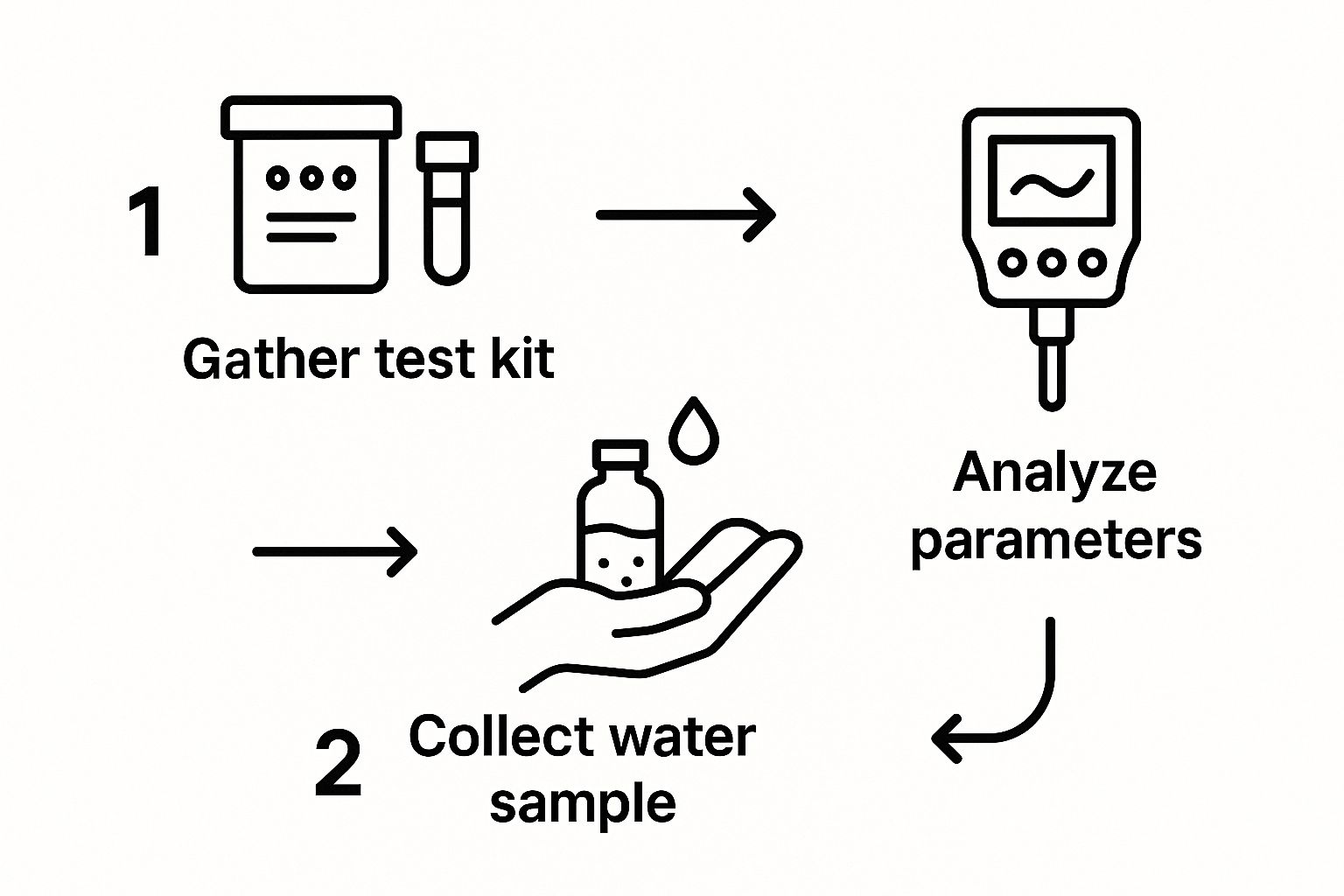
This simple flow—gather, collect, analyze—is the bedrock of every single test you'll run. Nail this, and you'll get consistent, accurate results every time.
How to Collect an Accurate Water Sample
First things first, you need a clean sample of your tank water. This sounds almost too simple to mention, but how you collect it really does matter.
- Go Below the Surface: Don't just scoop water from the very top. The surface can collect a film of dust and proteins that can throw off your readings. Plunge your test tube or a clean cup a few inches down into the tank. This gives you a much better picture of what's happening in the main water column.
- Avoid the Substrate: On the flip side, try not to get too close to the gravel or sand. Scooping water right off the bottom can suck up bits of fish waste and other gunk that hasn't broken down yet, which could give you a falsely high ammonia or nitrite reading. The middle of the tank is your goldilocks zone.
Think of it this way: a clean, representative sample is the foundation of a reliable test. Any contaminants, no matter how small, can interfere with the chemical reactions and send you down the wrong path.
Running the Test with Precision
With your water sample ready, it's time to play chemist. Consistency is your absolute best friend here. You should always follow the specific instructions that came with your kit, but there are a few universal pointers that will make a huge difference.
If there's one mistake I see people make over and over, it’s not shaking the reagent bottles enough. Some of those chemicals, especially the second bottle in most nitrate test kits, have crystals that settle at the bottom. If you don't mix them up properly, your test result will be junk. Seriously, shake that bottle like you mean it for a good 30 seconds.
Always give your test tubes a quick rinse with tank water before and after you use them. It's a simple habit that prevents cross-contamination. You don't want a stray drop from your ammonia test messing with your pH reading.
Finally, lighting makes all the difference. When it's time to compare your test tube to the color chart, do it in a well-lit room—natural daylight is best if you can get it. Hold the tube right up against the white part of the chart for the truest comparison. Trying to eyeball it under a dim, yellowish lamp is a surefire way to misread the results. Getting these little details right is what builds confidence in your data.
What Your Test Results Are Actually Telling You
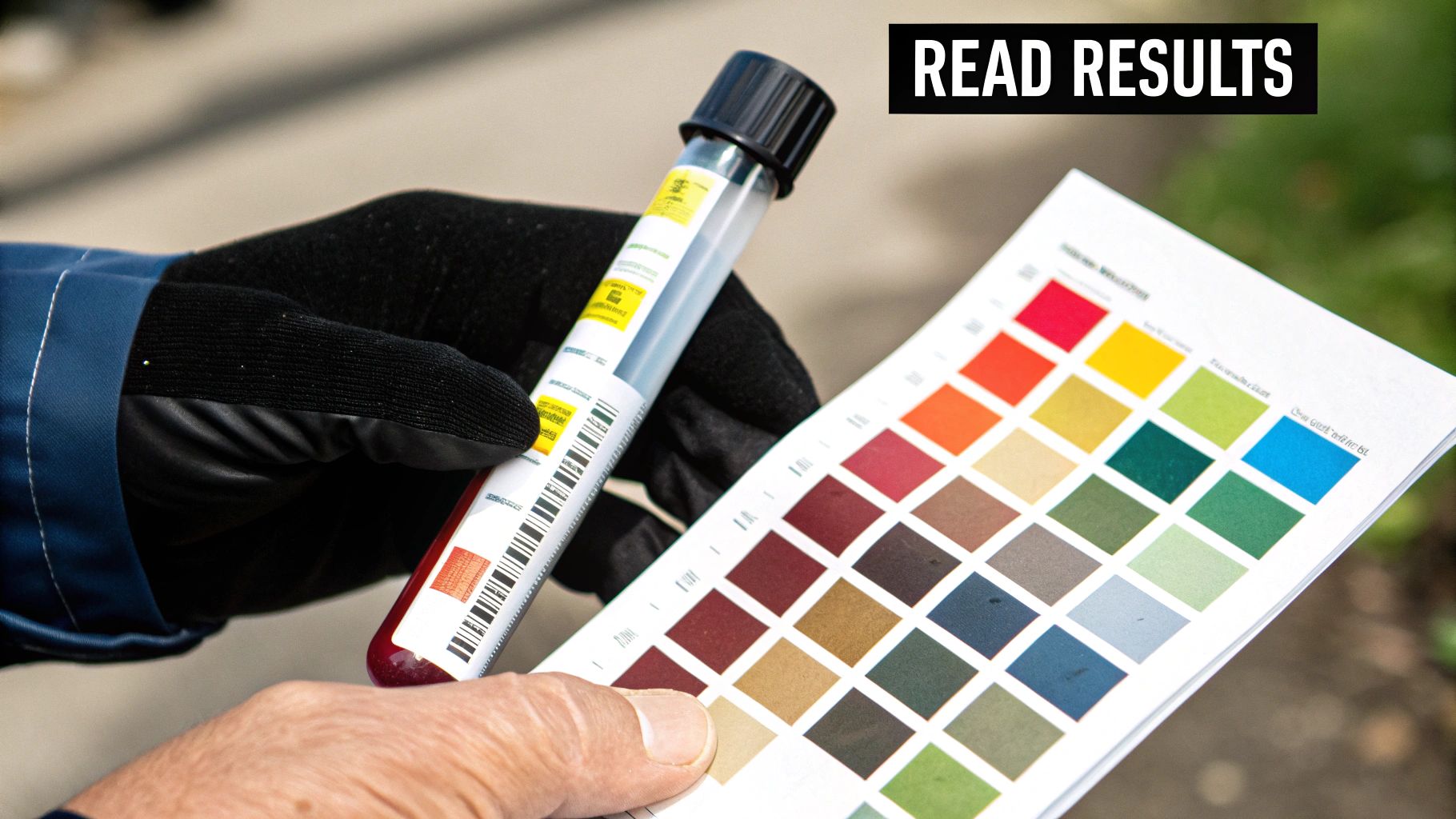
A test result is just a colored vial or a number on a chart until you understand the story it's telling about your tank. Learning to translate this data into action is what separates the novices from the seasoned aquarists. It's the key to proactively managing your aquarium's health, not just reacting to disasters.
Take ammonia, for instance. Any detectable reading is a major red flag. A result of 0.25 ppm isn't just "a little high"—it's an urgent call to action. This signals your biological filter is struggling, and you need to perform an immediate water change and likely use an ammonia-neutralizing water conditioner.
Nitrate, on the other hand, tells a completely different story. In a healthy, established planted tank, a nitrate reading of 5-10 ppm can be a great sign. It shows your nitrogen cycle is complete and chugging along perfectly. But if that number starts creeping up toward 40 ppm, it’s your tank's way of telling you it's time to dilute the buildup with a water change.
The Power of Spotting Trends
This is where keeping a simple log book becomes one of your most valuable tools. A single test result, viewed in isolation, can be misleading. While liquid kits are the gold standard for hobbyists, it's important to remember they aren't perfect.
It's crucial to understand that common drop titration kits can have error margins between 5% and 20%. A reading of 380 ppm one day and 420 ppm the next might just be testing variability, not a true chemical shift. This is why tracking trends over time provides much more reliable information than reacting to a single number. Find out more about testing accuracy on LiveAquaria.com.
Jotting down your results each week helps you see the bigger picture.
- Is pH slowly and consistently dropping? This could be a sign that your carbonate hardness (KH) is being depleted and you may need to add a buffer.
- Are nitrates always high by water-change day? This is a classic indicator that you might be overfeeding or that your current water change schedule isn't quite enough to keep up.
Spotting these patterns empowers you to make small, proactive tweaks instead of scrambling to fix big, stressful emergencies. You stop being a data collector and become a truly informed aquarium manager.
Once you've mastered testing for the nitrogen cycle, it's time to look at the bigger picture. Think of ammonia, nitrite, and nitrate as your aquarium's immediate vital signs. Now, let's explore the parameters that create long-term stability and keep those vitals in a healthy range. This is where we get into General Hardness (GH) and Carbonate Hardness (KH).
General Hardness (GH): The Building Blocks of Health
General Hardness (GH) is simply a measure of the dissolved minerals in your water, primarily calcium and magnesium. These aren't just random minerals; they are absolutely essential for the health of your fish and invertebrates. They play a direct role in everything from healthy scale growth and slime coat production to ensuring proper egg development during breeding.
Every fish species has evolved in a specific environment with a particular mineral content. This is why knowing your GH is so important. If you're keeping hard-water fish like African cichlids, they need those minerals. On the other hand, soft-water species like many tetras or discus can be stressed by water that's too hard. A GH test kit helps you match your water to your fish's natural needs.
Carbonate Hardness (KH): Your pH Insurance Policy
Now, let's talk about Carbonate Hardness (KH). I like to think of KH as the aquarium's built-in defense system against dangerous pH swings. It directly measures the water's buffering capacity—its ability to absorb and neutralize acids without letting the pH plummet.
A stable KH level is like a bodyguard for your pH. Without a sufficient buffer, natural biological processes can produce acids that cause the pH to crash suddenly, which is incredibly stressful and often fatal for fish.
For anyone with a high-tech planted tank or those keeping particularly sensitive fish, KH is every bit as critical as the nitrogen cycle parameters. It’s the secret ingredient for the rock-solid stability these delicate setups demand.
Finally, while our test kits give us crucial chemical data, don't forget to use your eyes. Water clarity is another great indicator of a healthy, well-filtered system. Interestingly, some fascinating research on water clarity and filtration found that achieving crystal-clear water required a filter media surface area at least twenty times greater than what was needed just for ammonia processing. This really drives home the point that robust, oversized filtration is just as important as your water chemistry.
Common Water Testing Questions Answered
https://www.youtube.com/embed/WIqMMVVGI98
Even with a solid testing routine, you're bound to run into questions. That’s perfectly normal. Getting the hang of water testing is a process, so let's walk through some of the most common issues that pop up for aquarists.
How Often Should I Really Be Testing My Water?
This is probably the number one question I hear, and the honest answer is: it depends on your tank. There’s no single schedule that fits every aquarium.
- For a Brand New Tank: When you're cycling a new aquarium, you need to test for ammonia and nitrite daily. This isn't optional. It’s the only way to see if your biological filter is developing correctly.
- For an Established Tank: Once your tank has been up and running for a month or more, a weekly check-in is usually sufficient. Testing pH, nitrate, and KH once a week is a great way to spot any gradual changes before they become problems.
- Any Time You See Trouble: Always test your water immediately if you notice anything off. This could be fish gasping at the surface, cloudy water, or general lethargy. You should also test after big changes, like adding new fish or treating the tank with medication.
Is It Okay to Use an Expired Test Kit?
I get it, it’s tempting to use that old kit you found in the back of the cabinet to save a few bucks. But please, don't. The chemical reagents in those little bottles have a shelf life, and they lose their accuracy over time.
Using an expired kit can give you results that are dangerously wrong. It might show zero ammonia when there's actually a spike, or it could send you on a wild goose chase trying to "fix" a problem that doesn't even exist.
Think of your test kit like a medical diagnostic tool. Its accuracy relies on fresh, potent reagents. Trusting an expired kit is like navigating with a broken compass—it’s more likely to lead you astray than to help.
My Tank Is Stable. Do I Still Need to Test?
Absolutely, yes. An aquarium might look stable on the surface, but it's a living, dynamic ecosystem. Things can change in a heartbeat.
A sudden equipment failure, a fish that passes away unnoticed behind a rock, or even an accidental overfeeding can trigger a massive ammonia spike. Regular testing is your early warning system. It helps you catch these issues the moment they start, not after they've already put your fish at risk.
At BlueRipple Aquatics, we know that an empowered aquarist is a successful one. We provide everything from stunning, healthy livestock to the essential gear you need to build a beautiful, thriving aquarium. Check out our selection and find your next centerpiece fish or a vibrant new coral by visiting https://bluerippleaquatics.com.
Article created using Outrank

